
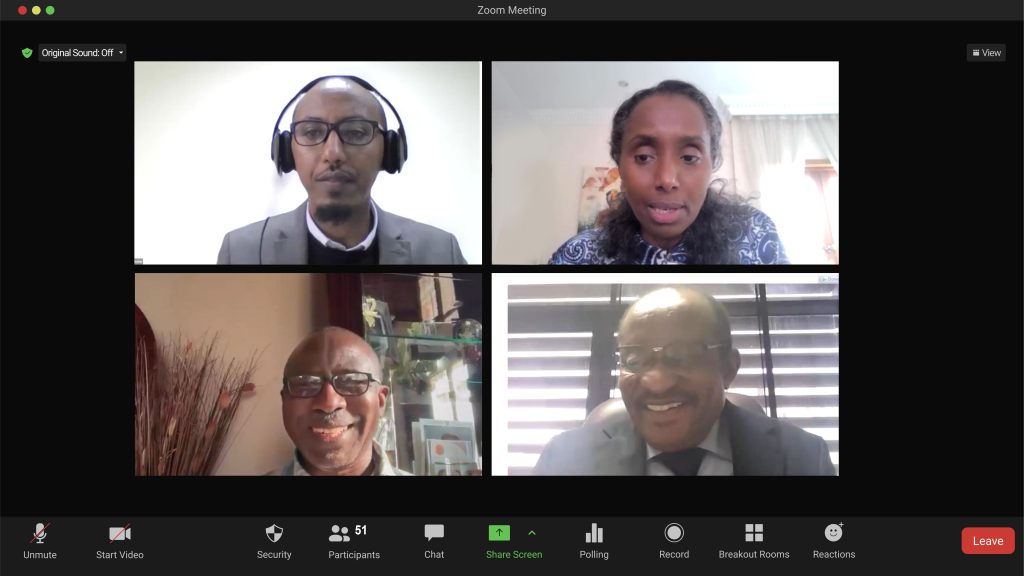
August 29 – The Secretariat of the African Union High Level Panel on Illicit Financial Flows released a new report, Successes and Challenges of Implementing the Recommendations of the African Union High Level Panel on Illicit Financial Flows, which indicates that most African countries fall short of meeting the institutional, policy and law enforcement requirements to effectively contain IFFs. The report, launched on Wednesday, August 27, 2025, shows that the continent lacks an effective coordination mechanism for a coherent and coordinated action against the scourge of IFFs.
Taking stock of the global geopolitical and policy changes that happened in the last 10 years since the Panel’s report, the Secretariat’s new report shows that the global landscape has changed so much that Africa’s vulnerability for IFFs has significantly increased. It highlights that US-China rivalry, CoVID-19, Russia-Ukraine War, and the emergent geopolitics of climate change and sovereign debt are some of the major factors that shifted the ground. The report reveals that Africa’s very high extra-region export ratio illustrates its vulnerability to external shocks and IFFs.
The increasing focus on taxation through popularizing the phrase Domestic Resource Mobilization (DRM) perpetuates an outdated, dysfunctional and unfair international financial architecture, the report argues. This not only sways the discussion away from a critical element of domestic resource creation, but it also limits the role of the state to “mobilizing” resources. Hence, according to the report, Africa needs a policy approach that encompasses domestic resources creation and mobilization (DRCM).
The report also looks into the coordination platforms that Africa put in place to consolidate its actions against IFFs. Although the AU HLP – IFF remains the primary mandated body to advocate for a consistent and coherent African response against IFFs, its efforts to create a functional coordination platform did not succeed. The report highlights that lack of institutional commitment, absence of shared vision, inefficient capacity and interventionist donor policies are the major limitations. Amongst the five sets of recommendations of the AU HLP – IFF, Africa has progressed well on institutional aspects. Most AU member states have established financial intelligence transfer pricing units, anti-corruption agencies and beneficial ownership registries. However, lack of synergy and capacity shortcomings limit the optimal use of these institutions.
In the other four sets of recommendations, African countries failed short of meeting basic standards. The report highlights that undeveloped customs database, poor regulation of non bank institutions, cash-based economic activities, unregulated foreign exchange bureaus, lax in non-resident account opening, lack of integrated sanctions management system and inferior national level transparency initiatives are posed as challenges that increase vulnerability of countries for IFFs.
Commenting on the release of the Report, Souad Aden-Osman, executive director of Coalition for Dialogue on Africa (CoDA), which hosts the Secretariat of the AU HLP – IFF, noted: “it is time for Africa to reflect on the journey it has come so far, and chart a future path in the fight against IFFs. This report reveals key institutional gaps that AU member states need to attend to if they are to contain the continued loss of development capital as illicit outflows. Creating effective coordination at national as well as continental levels should be the primary focus of policymakers.”
Prof. Florens Luoga, retired governor of the Bank of Tanzania and senior advisor of CoDA/AU HLP – IFF Secretariat, said that “Evaluation of the status of the fight against IFFs 10 years after the AU HLP – IFF report reveals mixed results. The existence of fragmented, non-inclusive, interest-based, non-consultative and unsustainable coordinating structures is a major hindrance to Africa’s aspirations of ebbing IFFs.”
The report highlights the following recommendations:
- Africa needs to focus on financing its growth, and structural and ecological transformation through its own financial systems.
- African countries need to shift away from DRM and move towards DRCM by establishing a network of public policy driven monetary institutions.
- The long overdue debate on the best methodology for measuring IFFs need to be settled with African countries adopting the joint use of PCM and PFM methodologies.
- Africa needs to use the AU HLP – IFF structures as coordination platforms for it is the only legitimate and mandated agency to consolidate continental actions.
- National level legislative and institutional efforts of fighting IFFs need to be underpinned with visionary leadership, regulatory adoptability, tailored capacity building programs and stringent law enforcement.
Download the Full Report: https://codafrica.org
Contact:
For more information, and interview requests, please contact:
Getachew Teklemariam Alemu
Senior Program Officer, CoDA/AU HLP – IFF Secretariat
alemug@africanunion.org
+251911245641


